90 Degree Tippers and Upender Buyers Guide
Posted: | Author: Cherrys Industrial
Sharing:
Buyer Guide
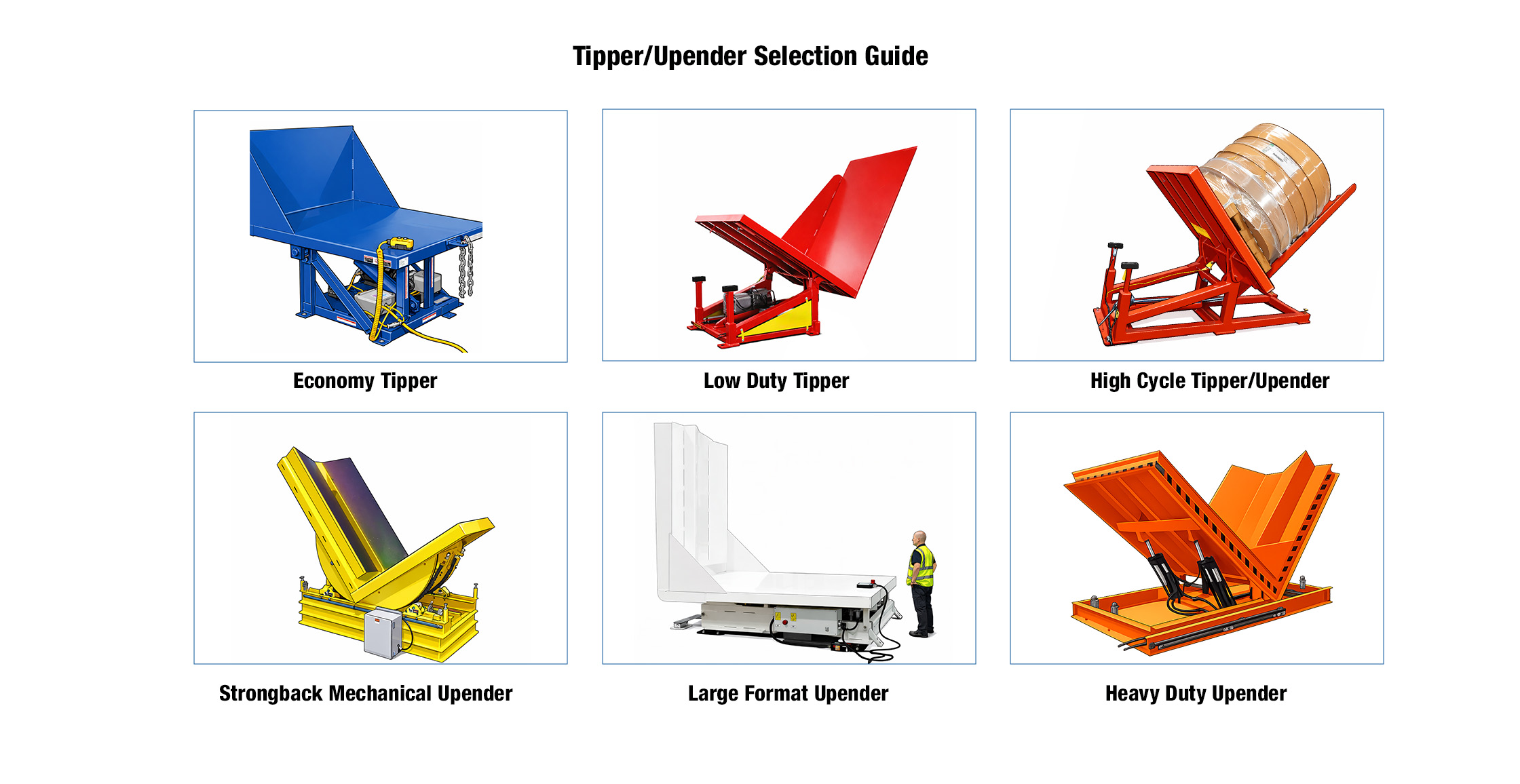
90 Degree Tipper/Upender Selection Guide
Compare roll and coil tipper designs side by side: mechanism, load capacity, configurations, and practical pros/cons so you can choose the right tipper for your roll handling, product orientation and production/shipping workflow.
Tipper/Upender Comparison
A quick side-by-side view of design tradeoffs: applicatiom, strength, handling, and construction method.
| Type | Design | Mechanism | Load Capacity | Loading / Application | Configurable | Key Features & Differentiators |
|---|---|---|---|---|---|---|
| Economy | Entry Level Tipper/Upender | Hydraulic | Light duty loads | Light coils, rolls, containers; intermittent use | Limited | Cost-effective solution for low-volume operations; simple 90° tipping; compact footprint |
| Low Duty | Standard Tipper/ Upender | Hydraulic | Up to 6,000 lbs | Low-volume pallet, coil or roll tipping or load orientation | Moderate | U.S.-made construction; proven hydraulic design; ideal for occasional production use |
| High Cycle | Industrial 90 Degree Tipper/Upender | Hydraulic | Up to 10,000 lbs | Frequent pallet, coils, rolls, tote, or load upending in production environments | Moderate | Engineered for frequent cycling; reinforced structure; smooth, controlled motion for throughput-driven operations. |
| Large Format | Oversized Load Upender | Hydraulic | Up to 20,000 lbs. | Large coils, dies, molds, paper rolls, bulky loads | High | Designed for oversized or awkward loads; robust construction; suitable for continuous industrial operation |
| Heavy Duty | High Capacity Upender | Hydraulic | Up to 80 tons | Mold handling and extreme-duty load tipping | High | Designed for 24/7 industrial use, Heavy duty Upenders rotate heavy, bulky loads such as coils, molds, dies, and paper rolls within a 90-degree radius. |
| Strongback | C-Frame Design | Electric gear motor with sprockets, shaft, heavy-duty chain & brake motor | Up to 30,000 lbs. | Portability, restricted areas, smaller footprint, precision | Fully custom | Custom-engineered for very heavy molds; positive load control; chain-and-sprocket strongback design delivers stability, precision, and long service life |
Pros
- Economy Tipper / Upender – Lowest capital cost option for basic load tipping, simple hydraulic design with minimal controls, compact footprint, easy to operate and maintain, suitable for light-duty and intermittent applications where cycle rate is not critical.
- Low Duty Tipper / Upender – Cost-effective solution for palletized loads up to 2,000 or 4,000 lbs, proven hydraulic mechanism, U.S.-made construction, reliable and straightforward operation, adaptable to a range of pallet sizes and load types with moderate customization.
- High Cycle Tipper / Upender – Designed for frequent cycling in production environments, robust hydraulic construction, smoother and more controlled motion, higher throughput capability than economy or low-duty units, configurable interfaces for pallets, totes, or custom load fixtures.
- Large Format Tipper / Upender – Built for oversized and bulky loads, reinforced structural design, hydraulic power suited for heavy industrial use, accommodates large coils, dies, molds, or paper rolls, customizable to match load geometry and material flow requirements.
- Strongback Heavy Duty Upender – Custom engineered for extreme loads up to 30,000 lbs, strongback frame provides exceptional stability and load control, smaller footprint compared to traditional large-format hydraulic upenders, easier to move and relocate, electric gear motor with chain and sprocket drive delivers precise, positive movement, brake motor enhances safety during rotation, ideal for mold handling and high-risk applications requiring maximum rigidity and control.
Watchouts / Cons
- Economy Tipper / Upender – Limited capacity and duty cycle, not suited for continuous or high-throughput operations, fewer customization options, shorter lifecycle in demanding production environments.
- Low Duty Tipper / Upender – Not intended for high-cycle or continuous use, limited throughput compared to high-cycle systems, may require operator intervention at load and unload, not ideal for automation-heavy environments.
- High Cycle Tipper / Upender – Higher initial capital cost than economy or low-duty units, increased hydraulic system complexity, requires proper maintenance planning to support frequent cycling.
- Large Format Tipper / Upender – Larger footprint and higher installation requirements, increased utility demands, higher upfront investment, typically requires site-specific engineering and longer lead times.
- Strongback Heavy Duty Upender – Fully custom design results in higher engineering and build costs, longer design and fabrication timelines, increased maintenance requirements due to sprockets, chains, shafts, and additional moving parts, larger footprint and structural foundation requirements, and is typically dedicated to a single load type rather than flexible, multi-use applications.
Best Use by Tipper / Upender Type
Quick recommendations based on what matters most: budget, capacity, durability, or asset life.
Economy Tipper / Upender Model: EM1-500 Series
Best suited for light-duty, intermittent tipping applications where budget is the primary driver, cycle rate is low, and loads are relatively uniform, such as small operations, maintenance departments, or non-production environments.
Low Duty Tipper / UpenderModel: LDT-2000-T1, LDT-2000-T2, LDT-2000-T3, LDT-4000-T4
Best for low-volume production or warehouse applications handling palletized loads up to 2,000 or 4,000 lbs, where occasional tipping is required but continuous operation or automation is not necessary.
High Cycle Tipper / UpenderModel: HCT-6000-T2
Best for production environments requiring frequent or repetitive tipping throughout the shift, where throughput, reliability, and consistent motion control are critical, and where the Upender may be integrated into a semi-automated or automated material flow.
Large Format Tipper / UpenderModel: UC-10000-HDT
Best for oversized, bulky, or awkward loads such as large coils, dies, molds, or paper rolls that exceed the practical size limits of standard Upenders, particularly in heavy industrial settings with sufficient floor space and infrastructure.
Strongback Heavy Duty UpenderModel: SB-2050-MU
Best for extreme-duty mold handling applications up to 30,000 lbs where maximum rigidity, precise load control, and operator safety are critical, and where a compact footprint, controlled electric drive, and dedicated load orientation provide advantages over traditional hydraulic large-format systems.
Expert Tips When Selecting a Tipper / Upender
Safety First – Replace Unsafe Manual Practices
Many tipper and upender projects begin by eliminating unsafe legacy processes such as overhead hoists with slings, using multiple forklifts to tip and catch rolls, or manually turning heavy loads. These methods expose employees to uncontrolled movement, pinch points, and dropped loads. A properly designed tipper or upender creates a controlled, repeatable motion that significantly reduces risk. Involve your Environmental Health & Safety (EHS) team early in the selection process to ensure the equipment meets internal safety standards, includes appropriate guarding, load retention, and emergency stops, and protects employees throughout the entire movement cycle—not just at the start and end of the tip.
Flexibility Drives Adoption and Long-Term Use
Tippers that are configurable or custom-designed for the load type, size, and workflow are more likely to be used consistently and correctly. Flexibility in table size, load interfaces, controls, and orientation increases operator buy-in and reduces the temptation to bypass the equipment. Off-the-shelf models that are modified in the field by maintenance teams may limit capacity, compromise safety, or reduce functionality, often resulting in underutilized equipment or new risks introduced after installation.
Customization Should Be Engineered, Not Improvised
When loads vary in size, weight, or geometry, engineered customization is critical. Custom fixtures, strongback designs, or load-specific interfaces should be incorporated during the design phase rather than added later. Purpose-built customization preserves rated capacity, maintains structural integrity, and ensures predictable performance, whereas post-install modifications can reduce lifespan and increase maintenance exposure.
Return on Investment Goes Beyond Labor Savings
ROI should not be evaluated on labor reduction alone. Safety improvements, injury avoidance, reduced product damage, improved process consistency, and increased throughput all contribute to payback. Eliminating high-risk material handling methods can also reduce workers’ compensation exposure, lost-time incidents, and near misses—benefits that often outweigh direct labor savings when viewed over the life of the equipment.
Evaluate Total Cost of Ownership, Not Just Purchase Price
Total cost of ownership includes maintenance requirements, spare parts, downtime risk, energy consumption, and expected service life. Higher-duty or custom-engineered tippers may carry a higher upfront cost but often deliver lower long-term cost through increased reliability, reduced maintenance interventions, and longer operational life. Selecting the correct duty class for the application prevents premature wear and avoids costly retrofits or replacements later.
Work with a company that specializes in solving lifting, tipping, and turning challenges
Ensure the solution is engineered around your process, not forced into it. Many 90-degree tipping and upending applications stem from unsafe or inefficient handling methods, and a consultative partner applies disciplined discovery, in-house engineering, and structured project management to address root causes and deliver the correct solution. Ongoing after-sales support and a clear guarantee protect the investment, reduce risk, and ensure the equipment performs safely and reliably throughout its lifecycle.