Dispensing value: improved pallet storage and safety
 Overview
A globally recognized CNC (Computer Numerical Control) tool and machining shop, an industry leader with five decades of experience, contacted Cherry’s Industrial Equipment for assistance with a few critical material handling challenges at its Wisconsin facility. Previous attempts to find a workable solution with other providers had left the problems unresolved.
National Account Manager Jordan Smith represented Cherry’s in assessing the client needs and designing a solution.
The Challenge
The facility management sought solutions for several key material handling challenges: (1) Eliminating short pallet stacks positioned across the warehouse floor which reduced usable space; and (2) Providing a safer way for employees to interact with pallets. An additional problem they had was the use of “Grade B” pallets, of lesser quality construction, and the question of whether to upgrade the entire inventory of pallets or find a workaround solution.
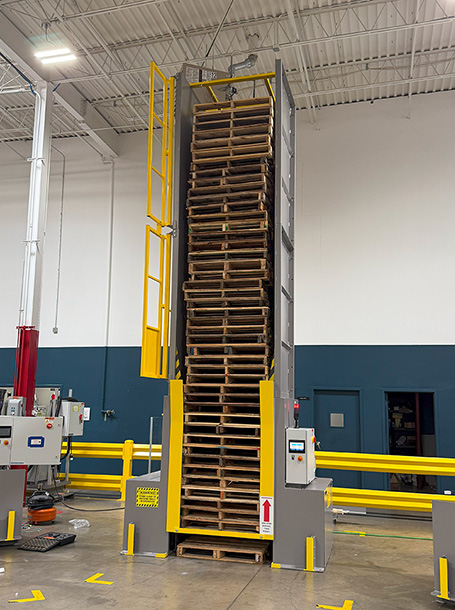
Stacks of pallets were present on the floor throughout the facility at any given time. The company produces many different parts ranging in size from very small to larger and heavier. Transporting pallets required an operator to walk to the stack, grab a pallet from the top, pull back, and place the pallet on the floor to prepare for shipment. This method posed major ergonomic concerns for workers: the repetitive motions of reaching, pulling and bending, coupled with the risk of inadvertently grabbing nails and splinters, or potentially dropping the pallet onto a toe or foot.
In addition to reducing potential injuries, the company sought a way to store pallets efficiently and thereby increase available floor space.
Cherry’s Industrial Equipment was brought in after the company had received a quote from another supplier; however, the customer viewed the first estimate but there were serious issues about viability and sought competitive options.
Concerning the Grade B pallets, previous suppliers advised the company to upgrade its entire pallet supply, a potentially expensive prospect.
Following discussions with the engineers and management at the facility, Cherry’s proposed a solution to address all of the company’s needs as revealed in the conversations: a pallet dispenser that would increase floor space utilization, reduce the need for manual pallet handling, and accommodate the Grade B pallets.
The Solution
Cherry’s recommended its PD4500 Pallet Dispenser, the “top of the line” in the market. Based on more than four decades’ experience, Cherry’s understood that, while there are less expensive models available which could address some of the client’s concerns, these models would not accommodate the Grade B pallets or handle the customer’s throughput. The PD4500 can handle Grade B. It can store up to 45 pallets and can dispense one pallet to the ground every 10 seconds. The PD4500 reduces “idle critical space” of pallets on the floor and eliminates the need for operators to physically reach and pull pallets from a stack. Instead, they can interact with the pallet at ground level. This particular dispenser met the speed and volume required for the overall operation to run smoothly.
The Results
The customer was initially contemplating choosing a less expensive pallet dispenser than the Cherry’s option proposed. During the discovery phase, we pointed out the importance of value and ROI as opposed to “bottom line” price. The Cherry’s solution delivered a dispenser with considerable speed and volume, significant pallet storage capacity, and one designed to work with the client’s existing pallet inventory. Cherry’s engineered, designed and delivered a product made in the USA, backed up by local support and service.
The customer appreciated the value and return on investment and, upon consideration, subsequently acquired two PD4500 Pallet Dispensers which have been placed into service. Prior to delivery of the machines, Cherry’s had the customer send a shipment of pallets to our test site to verify that the dispensers would meet customer expectations.
And they have! The client reports no issues or downtime in operations since placing the machines in service.
Conclusion
This is not a “one size fits all” industry. Dedicating the time to truly understand what a client needs is critical in providing true value. Another company might have recommended a dispenser which didn’t meet all of the client’s requirements (accommodating the Grade B pellets, for example) just to make the sale. That is not how we do business. Cherry’s does not simply “sell equipment;” we design solutions that work.
"We are thrilled with the purchase and the results. The equipment is phenomenal; and we will refer Cherry’s to others when we get the chance."
More Success Stories
The Pallet Problem Solver: A fix for AS/RS Efficiency
Learn how Cherry’s Industrial Equipment helped a global furniture manufacturer improve production efficiency and avoid assembly line bottlenecks, by providing a customized pallet straightener solution.
Learn More
Sorting out the issue: Costly roadblock into a scalable success
When a grocery distributor’s newly purchased, multi-million-dollar pallet sorting system couldn’t operate due to misaligned pallets, Cherry’s Industrial Solutions stepped in to solve the problem. By identifying...
Learn More
Tilting the odds towards greater success
Learn how Cherry’s Industrial Equipment helped a global meat packaging/cold storage facility improve its production efficiency with a 30% increase in speed for its lift/tilt tables, and...
Learn More