Pallet Washer Buyers Guide
Posted: | Author: Cherrys Industrial
Sharing:
Buyer Guide
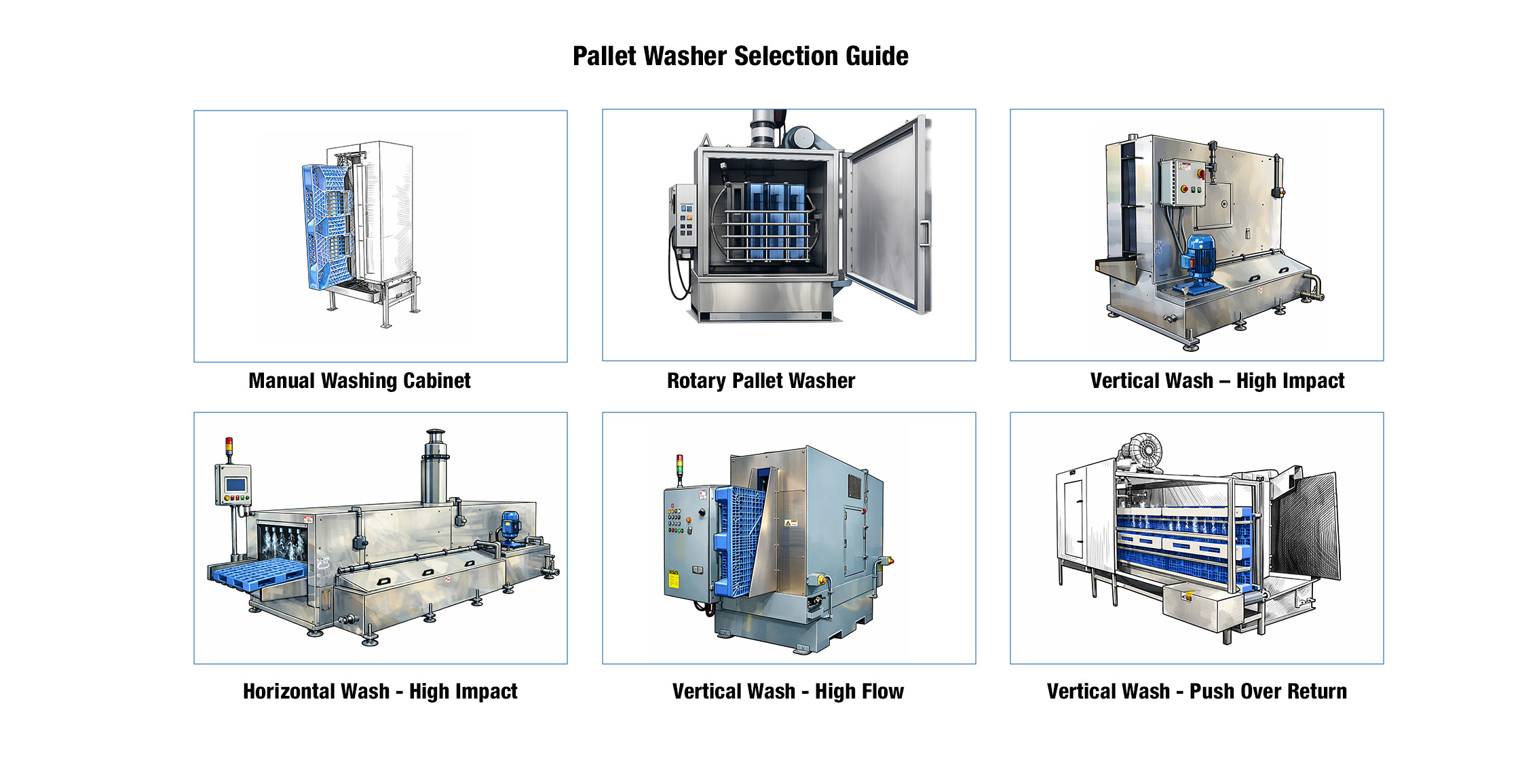
Pallet Washer Selection Guide
This guide provides a practical overview of the key factors to consider when selecting the right pallet washing system for your operation. It compares washer types and throughput rates, outlines the role of water temperature and sanitization in meeting food safety standards, and explains drying methods to ensure pallets are ready for reuse. The guide also addresses utility requirements—including water, power, steam, and drainage—and helps buyers evaluate total cost of ownership by balancing capital investment, operating costs, labor, and long-term performance.
Pallet Washer Comparison
A quick side-by-side view of design tradeoffs: material, pump and flow, throughput, and construction/design method.
| Washer Type | Material |
Recirculating Tank |
Pump/PSI at Nozzles |
Pallets per Hour |
Design | Key Features & Differentiators |
|---|---|---|---|---|---|---|
| Manual Washer Cabinet | 304 Stainless Steel | N/A | 5.9 GPM @ 50 PSI | 20-30* | Pass through cabinet with rollers | Low-pressure spot cleaning and rinsing; lowest throughput; highly operator-dependent |
|
Batch Pallet Washer - Rotary turntable
|
304 Stainless Steel | 200-Gallon | High GPM/Low PSI | 20-30* | Enclosed cabinet with fixed spray arms | Compact footprint; consistent wash pattern; utilizes chemistry; water does not accumulate on pallet; moderate throughput |
| Horizontal Wash - High Impact | 304 Stainless Steel | 200-Gallon | ~180 GPM @ 60 PSI (spray nozzles) | 60–100 | Horizontal pass-through | Aggressive cleaning for heavily soiled pallets; high-impact wash; recirculating water filtered through vertical and horizontal screen filters |
| Vertical Wash - High Impact | 304 Stainless Steel | 275-Gallon | 100 GPM @ 50 PSI (spray nozzles) | Up to 100 | Vertical pass-through | High-volume, low-pressure wash; energy-efficient; gentle on pallets; utilizes chemistry; recirculating water filtered through chip basket |
| Vertical Wash - Push Over Return | 304 Stainless Steel | 200-Gallon | ~180 GPM @ 60 PSI (spray nozzles) | 60–100 | Vertical pass-through | Same-side loading and unloading; high-impact cleaning; balanced throughput; recirculating water filtered through vertical and horizontal screen filters |
| *Estimated throughput varies significantly based on operator involvement, cycle time, and pallet condition. | ||||||
Pros
- Manual Wash Cabinet - Lowest capital cost, simple operation and maintenance, flexible for odd-sized or specialty pallets
- Batch Pallet Washer - Compact footprint, consistent wash pattern via rotating pallet turntable, utilizes chemistry effectively, rotation prevents water from pooling on pallet surfaces, enclosed design improves containment
- Horizontal Washer - High throughput capability, aggressive cleaning for heavy soils without detergents, continuous pass-through operation, effective filtration with vertical and horizontal screens, easier to load
- Vertical Washer – High Flow - Energy-efficient, low-pressure design, gentle on pallets and labels, smaller footprint than horizontal systems, effective use of chemistry, chip basket simplifies debris removal
- Vertical Wash – Push-Over Return - Same-side loading and unloading improves ergonomics, balanced combination of throughput and cleaning power, high-impact cleaning in a compact vertical design, reduced operator travel distance, effective filtration with vertical and horizontal screens, efficient use of floor space
Watchouts / Cons
- Manual Wash Cabinet - Very low throughput, highly operator-dependent consistency, higher labor cost per pallet, not suitable for production environments
- Batch Pallet Washer - Limited throughput, Batch process increases cycle time, not ideal for continuous-flow operations.
- Horizontal Washer - Larger footprint, higher water and energy usage, more complex installation and integration, lower effectiveness of spray nozzles
- Vertical Washer – High Flow - Less aggressive cleaning on heavy soils. May require detergents, or extended dwell times in the wash zone or pre-rinse in extreme conditions.
- Vertical Wash – Push-Over Return - Slightly lower throughput than horizontal systems, requires operator interaction at load/unload point
Best Use by Pallet Washer Type
Quick recommendations based on what matters most: budget, airflow, durability, or asset life.
Manual Wash Cabinet Model: PPW-2500
Low-volume operations, maintenance or rework areas, spot cleaning, rinsing, or pre-wash applications and facilities with limited floor space and budget
Batch Pallet WasherModel:
Small to mid-sized operations with limited floor space that prioritize consistent wash results over maximum throughput, particularly in applications where chemical dwell time is critical.
Horizontal WasherModel:
High-volume food and pharmaceutical manufacturing, heavy soil, residues, oils or sticky product environments, automated or semi-automated material handling lines
Vertical Washer – High FlowModel: PPW-C24-SZ3
Food, beverage, and pharmaceutical applications with light to moderate soil levels. Facilities seeking lower operating costs focused on sanitation and pallet longevity.
Vertical Washer – Push Over ReturnModel: KPW1MC-8-15-POR
Medium to high-volume operations, facilities with limited floor space, plants prioritizing ergonomic workflow, labor reduction and reduced travel distance
Expert Tips When Selecting a Pallet Washer
How clean and how dry the pallet must be after washing.
Some applications only require visible debris removal, while others—such as food, beverage, pharmaceutical, or cold storage environments—may demand a higher sanitation level and minimal residual moisture. The required dryness will influence whether blowers, air knives, extended drip zones, or heated drying stages are necessary.
Evaluate water temperature and sanitizer requirements
Based on the pathogens you need to control, hot water washing, combined with approved sanitizers or chemistry, plays a critical role in killing bacteria, mold, and other contaminants. Confirm that the system can reliably achieve and maintain the target wash and rinse temperatures, and ensure the selected sanitizers are compatible with both the washer design and the pallet material.
Assess utility availability and infrastructure before selecting equipment
Heated wash systems may require hot water supply, steam, or electric tank heaters with sufficient electrical amperage. Drying systems such as blowers or fans increase electrical demand and may require ducting to manage heat and moisture. Condensation control is especially important in enclosed facilities or cold environments.
Plan for drains and plumbing to support daily operation and maintenance
Recirculating systems require make-up water to account for evaporation and carry-out loss. Adequate floor drains are needed for tank dumps, filter cleaning, and routine sanitation. Easy access to reservoirs, chip baskets, and filter screens will reduce downtime and improve long-term reliability.
Consider labor requirements and automation level
Manual or semi-automatic systems rely on operators to load and unload pallets, which impacts throughput, consistency, and ergonomics. Fully automated or pass-through systems reduce labor dependence, improve repeatability, and support higher volumes but require greater upfront investment and integration planning.
Consider plastic pallet construction and design
Work with an experienced pallet and washing system expert to confirm that your specific pallet type is conducive to effective washing and drying. Some plastic pallets are hollow, others are two-piece designs bonded together, and some include internal cavities or complex geometries that can trap water, debris, or cleaning chemistry. These design characteristics can make thorough cleaning and complete drying more difficult and may influence washer configuration, spray orientation, dwell time, and drying requirements.