Stretch Wrappers Buyer's Guide
Posted: | Author: Cherrys Industrial
Sharing:
Buyer Guide
Stretch Wrapper Selection Guide
Selecting the right stretch wrapper directly impacts load stability, film usage, labor efficiency, and long-term operating cost. This guide compares common stretch wrapper styles, explains when each is the best fit, and highlights key factors that influence performance in real-world operations.
Stretch Wrapper Comparison
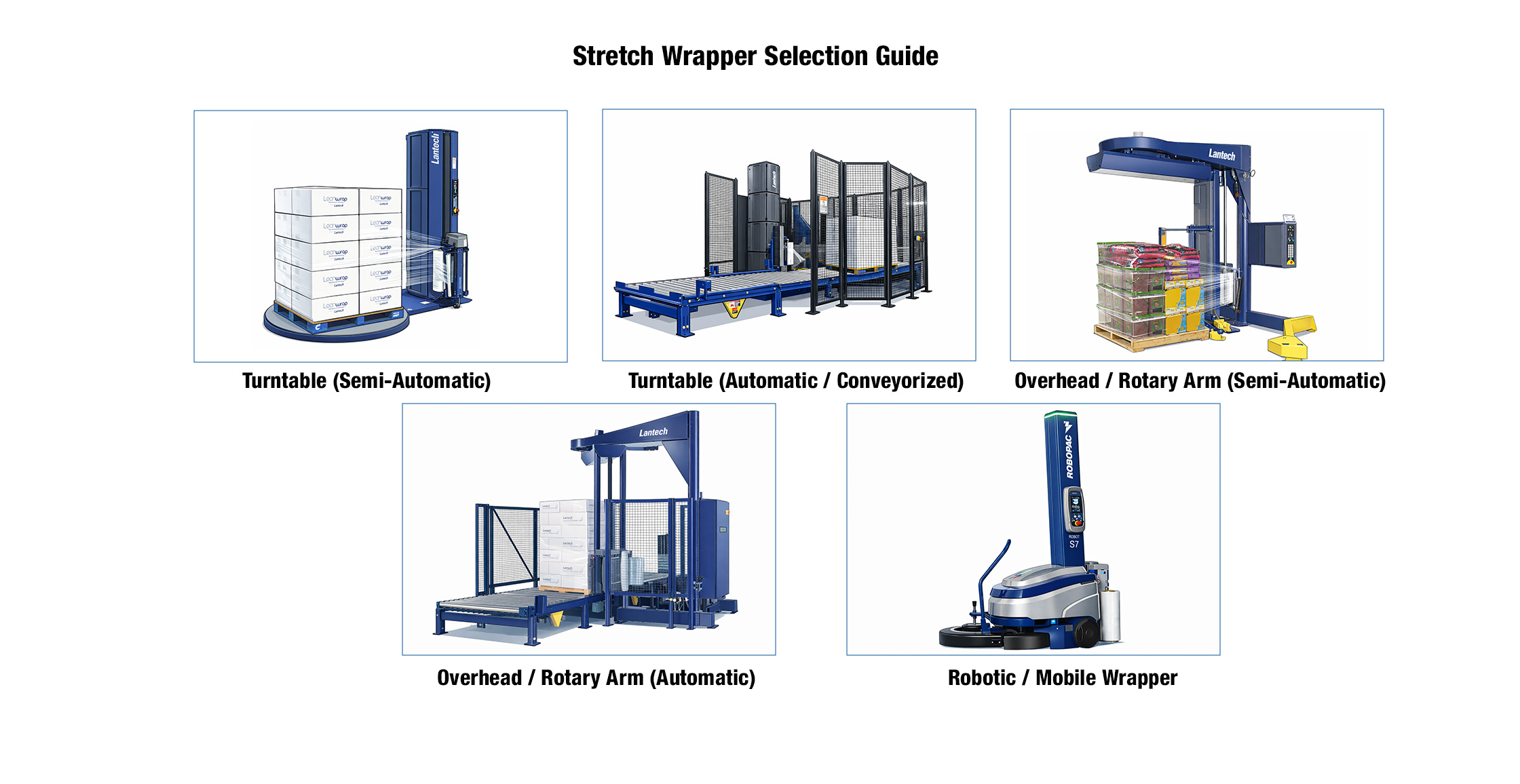
| Style | Type | Typical production speed (pallets/hour) | Typical / max pre-stretch | When this style is the best fit |
|---|---|---|---|---|
| Turntable (load rotates) | Semi-automatic | 20–35 (operator loads/starts) | 150–300% typical (depends on carriage option) | Stable, uniform loads; lowest cost entry; common for shipping/warehouse "wrap station" use |
| Turntable (load rotates) | Automatic / conveyorized | 35–80 (varies with load handling, top sheet, label, etc.) | 200–300% typical | You have conveyors already, want consistent wrap results, and need throughput beyond a manual wrap station |
| Overhead (rotary arm / ring) | Semi-automatic | 20–35 (operator loads/starts; load stays still) | 150–400% (common on powered pre-stretch carriages) | Unstable, tall, very heavy, very light loads where you don't want to spin the pallet |
| Overhead (rotary arm / ring) | Automatic / conveyorized | 50–120 (site-dependent) | 200–300% typical (higher possible by model) | High-mix or fragile loads on conveyor; need automation without rotating the pallet |
| Robotic (mobile wrapper drives around load) | Semi-automatic (operator positions robot) | 10–25 (highly variable) | 150–300% typical | No fixed wrap station; wrap loads in multiple locations; oversize footprints; leased/temporary space |
Brand Differentiators
Lantech
Lantech is widely positioned around load containment integrity, repeatability, and long-term uptime. Their stretch wrappers are engineered to deliver consistent wrap force and film application, helping reduce load damage and film waste across high-volume operations. Lantech emphasizes operator-friendly interfaces, robust mechanical design, and strong after-sales support, making the brand a common choice for facilities prioritizing process consistency, reliability, and total cost of ownership over the life of the equipment.
Robopac
Robopac is known for a broad and flexible product portfolio, covering turntable, rotary arm, ring, and robotic stretch wrapping platforms. The brand is frequently selected for applications involving unstable or lightweight loads, advanced film pre-stretch options, and facilities seeking data visibility, film optimization, and scalability. Robopac's strength lies in offering multiple configurations and technology options
that adapt well to complex end-of-line packaging environments.
Wulftec
Wulftec differentiates itself through heavy-duty construction, industrial controls, and simplified serviceability. Their machines are commonly specified for demanding warehouse and manufacturing environments where durability and ease of maintenance are critical. Wulftec places emphasis on non-proprietary components, rugged frames, and electrical standards suited for harsh conditions, making the brand attractive to operations with in-house maintenance teams and a preference for long-term mechanical robustness.
Other Key Factors to Consider When Selecting a Stretch Wrapper
| Factor | Why It Matters |
|---|---|
| Warehouse operating temperature | Cold or unconditioned environments affect film performance, sensors, and machine reliability. |
| Film quality and formulation | Film gauge, elasticity, and puncture resistance directly impact containment and downtime. |
| Installation requirements | Anchoring, power, air, guarding, and conveyor tie-ins affect total project cost and timing. |
| Load/unload height (ground vs. raised) | Impacts forklift or pallet jack access, type of machine and or ramp access, and operator safety. |
| Compressed air availability | Required for clamps, cutters, and top sheet dispensers; limited air may restrict options. |
| Portability and relocation | Mobile or non-anchored systems support layout changes or leased facilities. |
| Dock space and footprint | Space constraints near docks influence machine selection and traffic flow. |
| Forklift / powered walkie jacks travel time | Long travel distances increase labor cost and congestion around shipping lanes and may require additional machines or portability by bringing the stretch wrapper to the load. |
| Overwrap and film tail control | Excess film increases cost and can interfere with downstream automation. |
| Top cap / top sheet placement | Needed for dust, moisture, or UV protection; impacts speed and maintenance. |
| Cut-and-clamp capability (no air) | Eliminates manual film handling, improves consistency, and reduces injury risk. |
| Pallet grip | Improves stability for light or unstable loads during wrapping. |
| Wrap profiles and programmability | Enables SKU-specific containment zones and reduced film waste. |
| Integrated scale | Supports freight verification and compliance without adding process steps. |
| Remote control operation | Improves operator safety and efficiency in semi-automatic applications. |
| Remote monitoring and data | Visibility into film use, uptime, and alarms support continuous improvement. |
| Wrap height range | Ensures compatibility with tall, short, or mixed-height pallet loads. |
Best Use by Stretch Wrapper Type
Quick recommendations based on what matters most: budget, capacity, durability, or asset life.
Turntable (Semi-Automatic):
Stable, uniform pallet loads with moderate volume and minimal automation requirements.
Turntable (Automatic / Conveyorized):
High-volume, stable loads integrated into conveyorized end-of-line packaging systems.
Overhead / Rotary Arm (Semi-Automatic):
Unstable, tall, heavy, or lightweight loads that should remain stationary during wrapping.
Overhead / Rotary Arm (Automatic / Conveyorized):
Automated lines handling unstable or fragile loads requiring consistent containment without pallet rotation.
Robotic / Mobile Wrapper:
Low to moderate volume operations needing flexible wrapping locations and oversized load capability.
Expert Tips for Selecting the Right Stretch Wrapper
1. Start with the load, not the machine
Load characteristics should drive every decision. Evaluate pallet weight, height, footprint consistency, center of gravity, and stability. Tall, light, or unstable loads typically require a stationary-load solution (rotary arm or ring), while uniform, stable loads are well suited for turntable systems. Oversized or irregular loads may eliminate turntables entirely.
2. Match automation level to labor strategy, not just throughput
Semi-automatic machines are often selected for lower volumes, but labor availability, ergonomics, and operator consistency may justify automation at much lower pallet-per-hour rates. Automatic or conveyorized wrappers reduce variability, improve safety, and free labor-even when peak throughput is modest.
3. Understand true production speed requirements
Published pallets-per-hour ratings are often theoretical. Real-world performance is influenced by wrap pattern, film gauge, containment requirements, top sheet application, conveyor logic, and accumulation. Design for sustained average demand rather than short-term peak rates.
4. Prioritize film pre-stretch, film quality, and containment performance
Film cost typically exceeds equipment cost over the life of the machine. Powered pre-stretch carriages (commonly 200–300% or higher) can dramatically reduce film usage, but results depend heavily on film quality and consistency. Lower-quality film may neck down excessively, lose elasticity, or break under tension, reducing containment even at high pre-stretch levels. Film roll length and roll diameter also affect performance, as shorter rolls increase changeover frequency, operator intervention, and downtime, while longer rolls support more consistent wrap force, improved uptime, and better repeatability-especially in higher-volume operations. The best outcomes come from matching pre-stretch capability with the correct film formulation, gauge, and roll length.
5. Focus on load containment, not just the number of wraps
More wraps do not automatically equal better load stability. The objective is repeatable containment force that protects product while minimizing film consumption. Look for machines that allow precise control of film tension, banding, and reinforcement zones rather than relying on operator judgment.
6. Evaluate safety and ergonomics early
Stretch wrapping is frequently a late-stage manual task and a common source of repetitive motion injuries. Assess film loading height, operator reach, pinch points, and the need to bend or walk around loads. Automation, guarding, and ergonomic design can materially reduce injury risk and associated costs.
7. Plan for future loads and operational growth
Loads evolve over time due to new SKUs, packaging changes, higher stacking, or different pallet types. Select a wrapper with sufficient capacity, adjustability, and upgrade paths so the system does not become a constraint as your operation grows.
8. Assess facility constraints and system integration requirements
Ceiling height, floor conditions, available power, compressed air, and conveyor layout all influence machine selection. Overhead systems require vertical clearance, while robotic wrappers demand floor space and traffic planning. Early coordination with engineering and maintenance avoids costly modifications later.
9. Look beyond purchase price to total cost of ownership
Total cost of ownership extends well beyond the initial machine price. Consider film savings, labor reduction, maintenance, spare parts availability, uptime, and service support, along with damage reduction from improved load stability and consistent product containment during handling and transportation. Poor containment can lead to crushed product, pallet failures, rework, customer claims, and chargebacks-costs that often outweigh differences in capital cost over the life of the equipment.
10. Validate performance with testing or a pilot program
Whenever possible, test your actual loads and film on the proposed wrapper. Observing load behavior, film recovery, corner protection, and stability through handling and transport provides insights that specifications alone cannot capture.