Purchasing Capital Equipment Online is like Self-Diagnosing a Medical Condition
Posted: | Author: Cherrys Industrial
Sharing:
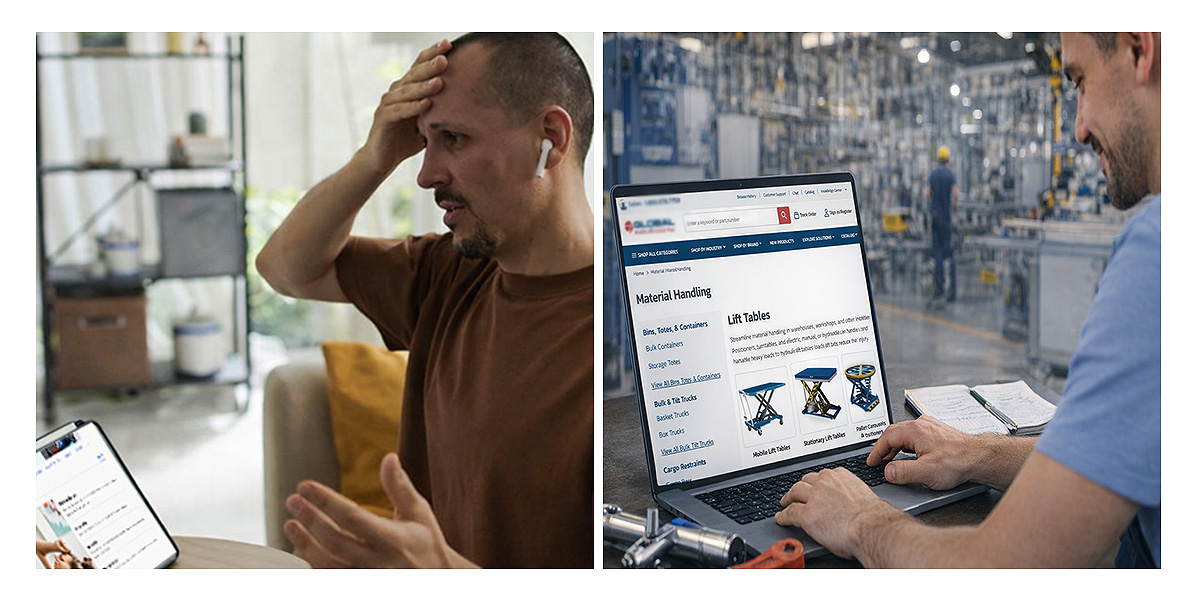
Would you trust the Internet to diagnose a complex medical condition of yours?
Probably not.
Would you trust the Internet to guide you through the research and purchase of a major piece of capital equipment, such as a pallet inverter or a 90 degree tipper?
Hopefully not!
The Internet makes it easy to do research and conduct business from the convenience of your laptop. Online resources powered by AI will deliver volumes of information on any topic – which can be great for some purposes, such as researching which brand of outdoor grille matches your needs and budget.
However, there should be limitations to online research and purchasing. It is an extremely risky proposition, for example, to consider purchasing major capital equipment solely through online methods. Using this approach can lead to disappointment or even disaster.
It would be like using the Internet to self-diagnose a medical condition instead of consulting a physician.
Here is why an online capital equipment purchase can be risky, and what you should consider instead.
 |
A false sense of security.When researching major capital equipment online, it is easy to be lulled into a false sense of security. After twenty minutes of reviewing articles, videos and comparison charts, the terminology starts to make sense, and you may conclude that your research addresses the issues you are seeking solutions for. But does it, really? Like a medical self-diagnosis, this confidence and knowledge may be built on surface-level indicators, not a true understanding of the underlying issues that led you to consider this capital equipment in the first place. |
A medical doctor spends years in formal education and extensive hands-on clinical experience.More importantly, an MD has access to diagnostic tools—tests, imaging, lab work—that confirm what is happening beyond the symptoms. What might initially appear to be a simple issue may have a deeper root cause which only becomes clear through structured evaluation and experience. When individuals self-diagnose, they often head down a rabbit hole of assumptions, delay appropriate treatment, or focus on the wrong problem altogether. |
 |
 |
Capital equipment purchases should not be merely transactionalThere is a lesson here. Many material handling and automation solutions appear straightforward on the surface. Specifications, capacity ratings, and price points can give the impression that the decision is primarily transactional. In reality, though, performance, safety, integration, longevity, and total cost of ownership are influenced by factors not always visible or discussed in online content. Education is important. Informed buyers make better decisions. However, without expert discovery, application knowledge, and real-world validation, online research alone can obscure the true root cause of operational challenges. The most effective outcomes occur when education is paired with experienced guidance. This guidance comes from someone who will look beyond the symptoms, ask the right questions, and validate assumptions before a costly decision is made. |
In capital equipment, as in healthcare, knowledge is important. But expertise, context, and proper diagnosis will lead to the right solution.
 |
Find the right partner for your purchase.Successful buyers will reach beyond the Internet and find a partner: a company that approaches a problem in the same way a good physician would. When buying capital equipment, you need someone on your side-- not someone who simply reacts to symptoms, but someone who drills down, asks probing questions, and validates assumptions before prescribing a solution. A trusted partner brings significant advantages to the table: years of practical, real-world experience, a deep knowledge base drawn from hundreds of similar applications, and the discipline of a proven discovery process. A partner understands that what initially appears to be the problem may be merely a symptom of a larger operational, safety, or process issue. Rather than pushing a standard solution and sending the buyers on their way, the partner takes the time to uncover the real constraints, risks, and objectives driving the decision. |
Treating the symptom may provide short-term relief, but it rarely delivers long-term value. Solving the root cause requires context, pattern recognition, and experience-- none of which can be gained from a brief online search. When buyers work with a company genuinely invested in diagnosing the real issue, the outcome is more than just a piece of equipment. It is a solution that performs as intended, integrates properly, and supports the business long term.
Just as is the case in healthcare, the goal is not to leave with a prescription alone, but with confidence that the right problem was identified and addressed.
As you evaluate a major capital investment, beware of companies claiming they already understand your operation better than you do, that provide a quote almost immediately, and position their solution as “the best quality” at a significantly lower price. Much like a doctor who prescribes medication without an exam, this approach often skips the diagnosis entirely.
With capital equipment (and healthcare) the real test comes after implementation. If the solution does not perform as expected, or there is a lack of ongoing support, accountability, and follow-through, that can lead to downtime, safety exposure, and finger-pointing when problems arise.
Do not let that happen to you. Choose a partner, not just a supplier.Look for a company that takes the time to understand your operation, asks difficult questions, validates assumptions, and stands behind the solution long after installation. Start with a consultative conversation focused on uncovering the root cause—because the right diagnosis is far more valuable than a fast prescription. Working with a partner who understands your needs may just be the best Rx for your capital requirements. For nearly 45 years, we have been here to help—partnering with companies to solve operational challenges related to labor, worker safety, and plant efficiency.
|
|
