Sanitary Equipment to Reduce Pathogens

In evaluating best practices at plants that process, ship and receive food products, one word that must be front and center in every discussion is “sanitary.”
The plant manager’s highest responsibility, it can be argued, is to see that every square inch of space in the facility – walls, floors, and equipment – is 100% sanitary.
Sound a little obvious? Maybe so, but it can be a very tall order. There are unfortunately too many opportunities for contamination to be present in a facility. And, as some processing facilities have learned the hard way, with anything less than completely sanitary conditions, disastrous consequences can follow.
It only takes one outbreak of salmonella, listeria or Ecoli for panic to set in, leading to a loss of confidence in the quality of food products in the public’s mind, not to mention reversals in the business fortunes of the facility where it occurred.s
Consider the “what if’s” when it comes to processing facilities. A shipment of food ingredients arrives inside a bag, drum, supersack or corrugated box on a wooden pallet, for example. The contents are then transferred into a large auger via a stainless-steel dumper or mixing bowl by hand. From there the finished product is packaged and stored, either at room temperature or in cold storage, depending on the contents, and prepared for shipping to its next destination.
Reduce pathogens and contamination
Take the recent case of a meat processing facility where an outbreak of salmonella resulted in the deaths of eight consumers. Ultimately, in this instance the investigation traced the cause of contamination to the plant’s pallet jacks.
Source of contamination: Pallet jacks wouldn’t be top of mind when thinking of potential sources of contamination but in this instance that is exactly what occurred. The take-away is that literally every square inch of each facility must be accounted for when it comes to sanitary conditions – from the inbound pallets to the pallet jacks and everything in between. When there is an issue of contamination at a processing facility, investigating the source can be time-consuming because of the many potential sources. And while the investigation is ongoing, the public’s confidence may be diminished, and certainly the business itself is affected.
Expanded recall: A recent private label food manufacturer expanded a recall of frozen waffles to cover locations all across the United States and Canada. More than 600 frozen waffle products were recalled because of potential contamination with Listeria monocytogenes. The company discovered the issue during routine testing, and analysis pinpointed inconsistent performance of the company’s manufacturing assets. As is the case with other firms which experience recalls, the company suffered financial losses as a result
Prevention: There is an old saying that “an ounce of prevention is worth a pound of cure.” It’s good advice to put into practice for the floor of every processing facility, the equipment that is used in processing, and the practices and protocols throughout the entire supply chain.

We’ve helped hundreds of companies
At Cherry’s Industrial Equipment – we work with a number of food processing facilities to help them improve efficiency, reduce workplace injury, and to help them operate under clean, sanitary conditions.
Sanitary wash down equipment: Some processing facility managers equate “sanitary” with “stainless steel.” While stainless steel is a popular option in manufacturing and processing equipment, other materials can also be sanitary. Looking at a plant layout and assessing how to keep everything sanitary means looking at everything—loading dock, production area and especially the means of keeping everything clean.
How often (and in what manner) is the equipment cleaned? Are you using in-house pallets? How are the pallets scrubbed? Are there means of testing for potential pathogens that the facility regularly employs? Is Quality Control up to date on the latest equipment, cleaning techniques and industry trends?
A few trends that we are seeing include:
- Heightened interest in rigid, self-inspection practices at facilities
- Wash down pallet inverters and pallet changing equipment to keep wood pallets on the loading dock and inhouse pallets captive for use in production.
- An increase in requests for pallet washing systems with sanitizers, as managers recognize that the pallet is the backbone of their operation
- Several manufacturers and processors are switching from plastic to aluminum pallets, because these metal pallets are stronger, fire resistant and don’t flake and chip the way that plastic pallets can.
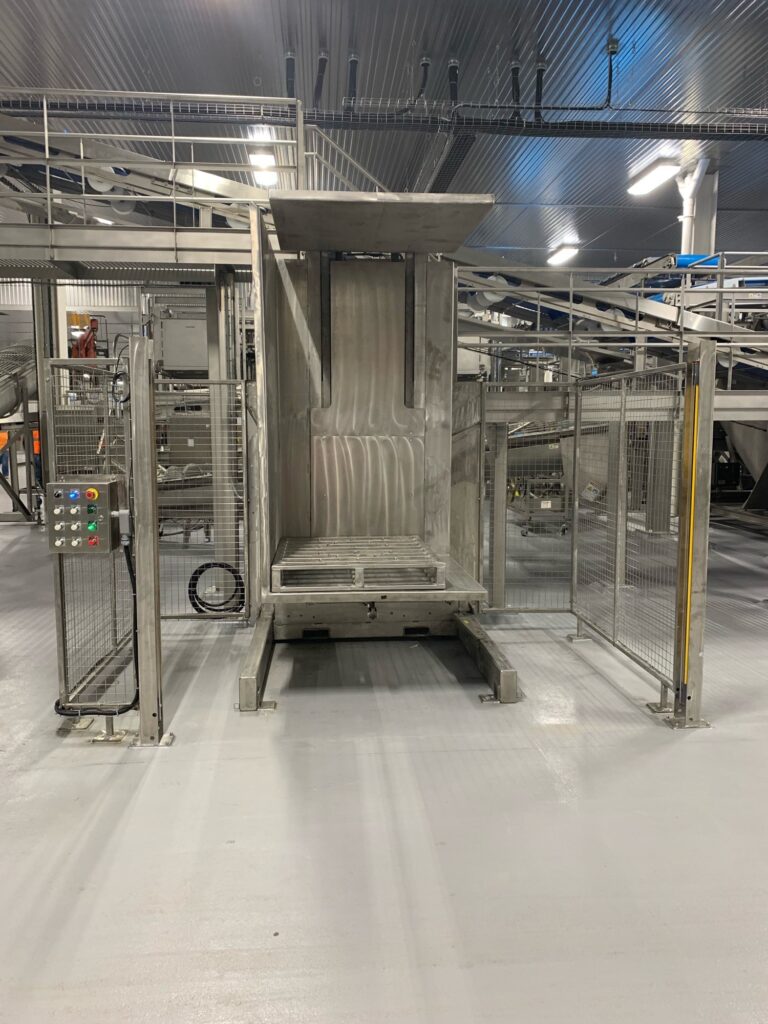
- Interest in stainless steel work assist lift tables for production areas which are corrosion-resistant and can be more easily washed
- An increased interest by manufacturers and managers to swab their pallets and test for pathogens
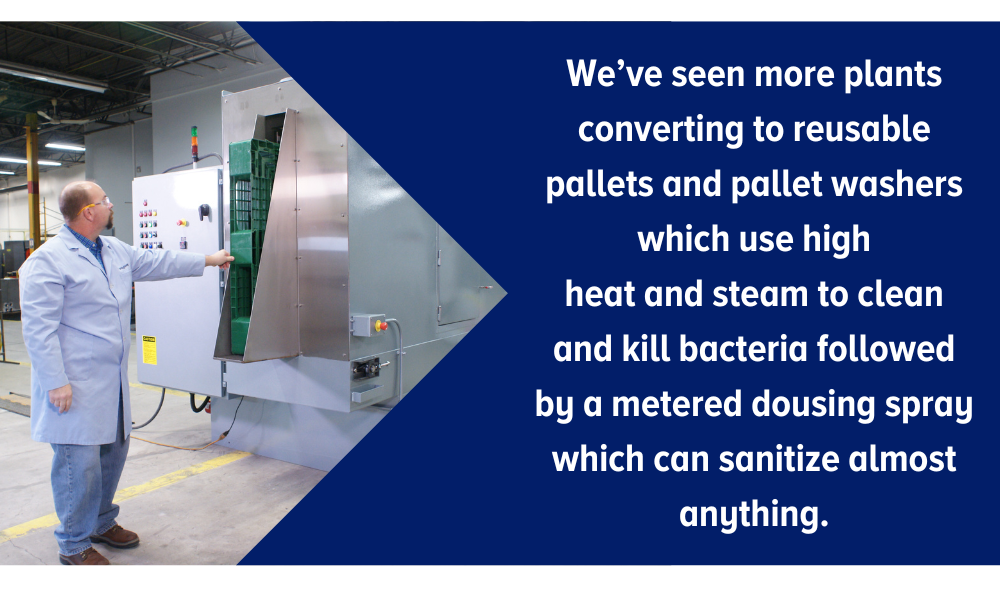
- Pallet washers which use high heat and steam to clean and kill bacteria followed by a metered dousing spray which can sanitize almost anything.
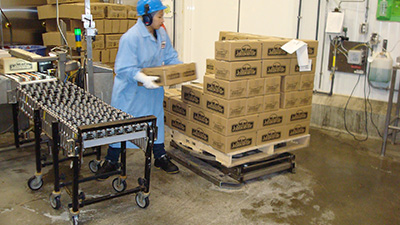
It starts with a clean pallet and a sanitation plan
Plants which experience contamination and recalls may not be intentionally lax in their practices. It’s just that there are so many moving parts in a facility and so many steps that must be implemented to assure that no contamination occurs. Sometimes, for example, a company manager may buy plastic pallets, but fail to wash or sanitize them. Think of how we all treat dirty plates by putting them through a dishwasher and sterilizing them for future use. That level of care for pallets and other equipment should be the norm, not the exception.
Reusable pallets

It is a long journey for food products from the field to the plate
Commitment to cleanliness: We visited a facility some time ago to discuss pallet washers. We were met at the door by their team which included both a macro and a micro biologist. We literally scrubbed up like a doctor might in preparing for surgery, with gowns and special footwear. Company officials were determined to do all within their power to avoid having any recalls. That’s a company that takes its commitment to cleanliness very seriously!
We are all food consumers – We must all do our part to ensure that food processing happens under sanitary conditions. If you have concerns about how to make your plant more sanitary and efficient, let’s have a conversation. We can discuss practical solutions to improve cleanliness, speed and efficiencies, and provide greater safety and stronger ergonomics, as well as improved workflow and use of loading dock space. Please contact Cherry’s Industrial Sales Department at 800-350-0011 or email [email protected]. We’re here to help!
Let us help you with your challenges