Leak Testing Automation
Our client, is a leading electrical transformer manufacturer for models such as the ones you’d see on utility poles and on roof tops. As part of the power grid, these transformers bring in power and transform it either up or down for facility use.
Transformers vary in size, with the largest units over 12 feet wide by 15 feet deep by 16 feet high. Technicians form and assemble the transformer tanks weld the steel walls, fins and other metals before the units move downstream to the paint booth. A critical step in the manufacturing process is a spray or bubble test to find leaks caused by bad or incomplete welds. Testing is crucial to a leak proof, safe, high quality product as the finished transformer is filled with a semi-conductive liquid to complete the electrical circuit.
The Challenge
Our customer has performed this weld and test process for years, during which we have provided them with several standalone tilt and test machines that help position the smaller transformers and pressurize the tank to help identify leaks .
However, as power consumption changed so did the need for much larger transformers which posed a unique challenge for our client. These units were so large that the company needed to devise a way of transporting the units with a combination of overhead cranes and large forklifts from the welding station into the leak test machine which was in a different area in the plant.
Our Solution
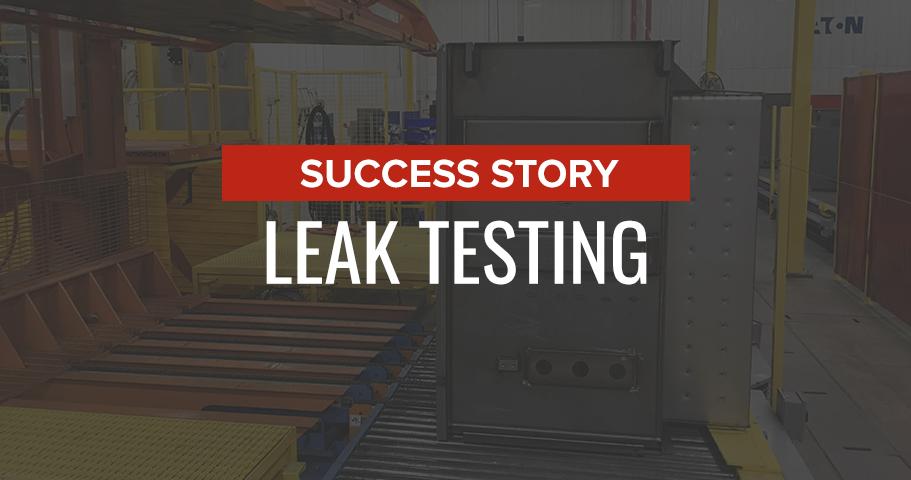
Our semi-automatic solution involved conveying the unit into our leak tester, where hydraulically operated arms and fingers locate and hold the top of the tank in place. A rubberized top platen lowers and creates a seal on the top of the transformer, then the transformer is filled with air pressurized to 3 pounds per square inch (psi).
The machine then tips the unit and extends bridging planks which allows the human operator to go in and position it so they can easily walk around it and access all the welds. The operator tests each weld for leaks by spraying a soapy testing liquid on all the welds — if any leaks are present, bubbles will form in the liquid. The operator can then mark these leaks for later repair or fix the defective welds on the spot.
Consider the time and resources that would be necessary to move everything in and out if the company was completing this process with a standalone machine. With our automated solution, the client was able to significantly increase productivity and throughput, which allowed them to handle larger transformers than they could with any standalone machine.
Another interesting note about this project is that the transformer would go through several fully automated processes before reaching the leak tester. Originally, the company used robots to spin the tank, turn it and weld it. However, after removing some of those robots from the welding process and bringing human beings back in, they found they were getting much better welds without the inconsistencies and errors.
Ultimately, this project demonstrates the true beauty of semi-automation by augmenting human operators rather than replacing them.
Learn More About Semi-Automatic Solutions From Cherry’s
We’ve been improving manufacturing processes with better machinery since 1983. Whether you produce electrical equipment or consumer goods, we can answer your questions about our products and services, including which solutions would work best in your facility.
Call us at 800-350-0011 to speak with a customer representative, or fill out our online contact form to request a quote or ask any questions you may have. Connect with us today to start on the path to more productive operations.