Cherry’s Industrial Equipment helps to power up the manufacturing process

Fueled by growth in data storage centers, upgrades to the power grid and pole transformers lost to natural disaters.

A global power manufacturing company sought to boost its production capacity; Cherry’s Industrial Equipment was brought in to assist. Cherry’s partnered with the manufacturer to design and co-develop a solution to a specific challenge that the company faced.
The company sought to streamline its manufacturing operation and add additional capacity by incorporating an application-specific, ergonomic 90° tipper/leak tester machine in its manufacturing process.
This solution would be applicable in the manufacturing of large electrical transformers. Transformers and other products that this power manufacturing company develops help customers solve power challenges and allows for people to work more safely, live more sustainably, and be more energy efficient.
The manufacturer faced the challenge of needing to add an automated version of a 90 degree tipper onto an existing line
Testing each part for leaks after the necessary welding has been completed is an important step in the process. Previously, the company achieved this by using both stand-alone leak testers and automated versions. However, existing units could not accommodate the newer transformers which are much larger in size and weight.
Automated 90° Tipper
The manufacturer specifically sought to integrate a larger automated version of a 90° tipper (where changing the product orientation and pressurizing the tank is an integral part of the production process) onto an existing line—with the ability to convey into the tipper automatically.
Cherry’s was selected in a global competitive bid to design and build this custom equipment, and then subsequently invited to design a similar machine for a new facility. Cherry’s has worked with this client since 1999, and in 2007 the design and construction of the first leak testing machine began.
Automation through the custom design both streamlines the efficiency of the operation and reduces the liklihood of worker injury.
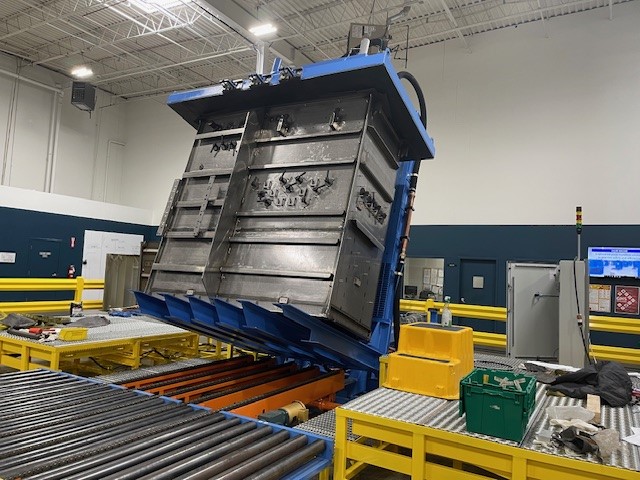
Upon integration, automation would increase efficiency and reduce the chance of worker injury through a series of steps.
Once the tank reaches the end stop position in the leak tester, the secondary (lower) platen would move down to seal the platen against the tank. Then, when safe, the operator would be able to enter the cell and manually secure clamping mechanisms at the lip of the tank on the front and back of the tank. Sensors would verify the clamp position.
Weld flex pressure test
From that point, the operator would leave the cell, initiate closure and lock the cell area. Then, the weld flex pressure test would be automatically performed, cycling the tank between +3 to -3 PSI (pounds per square inch). Following the weld exercise test, the operator would begin the weld soap test at the Human Machine Interface (HMI) station. The tank would be pressurized to 3 PSI. The operator would then adjust the position (tilt) of the tank, as necessary, at the HMI station and enter the cell, manually soaping the welds and repairing any leaks.
Because it is necessary to test all welding on the top, bottom and sides, an operator’s ability to maneuver around the machine is critical. To ensure the operator’s ability to do so, Cherry’s Industrial Equipment and the power manufacturing company’s design and engineering teams planned for the integration of lift tables into the process. If for any reason, an operator could not reach the top or sides of the transformer, a manlift lift can be positioned on either side of the leak tester to safely lift the operator up. The design also includes raised work platforms and bridges which can be moved in or out to provide additional access along the front once the tank is tipped.
Upon completion of testing and necessary repairs, the operator would return the positioner to the home or base position at the HMI. The operator would then disengage the manual clamps and leave the cell. From the HMI, the operator could start the automatic tank removal process. The secondary platen would be opened to remove the seal from the tank. The primary platen (upper) would raise up to allow removal of the tank from the cell. The leak test positioner would then transfer the tank onto the lift/transfer mechanism where it would be lowered and transferred onto the conveyor system.
Cherry’s collaborates with our clients’ engineering, design and safety teams
The Cherry’s team installed the new system and worked with the manufacturer’s team to make additional modifications on site, to be certain to meet and exceed an Omron safety audit and risk assessment prior to being put into service.
All integration has been accomplished between Cherry’s team and the manufacturer’s safety, EHS, manufacturing and management teams to ensure that the machine which was co-developed is working well and as intended.
The feedback after installation and integration is that the operators greatly value how they can position the tank, making it considerably easier to test for leaks and to weld. The system can now fill the tanks with air to pressurize at a much faster rate. The structural integrity of the welds is tested through a vacuum cycle. Overall operation is faster, safer and more productive. The product can lift and tilt, and the Cherry’s custom machine serves as the “constant” in the process that all parts go through before being shipped to the manufacturer’s customers.
The customized leak tester in place was termed “the Cadillac of all leak testers” by one of the operators, who said that in 20 years this was their best leak tester.
Cherry’s Industrial Equipment has a 40 year history of designing custom solutions for client needs. No two warehouses or manufacturing facilities are the same or have the same needs. Our team applies creative and critical thinking to each assignment with the goals of improving efficiency and reducing the likelihood of workplace injury. For additional information, please visit us at www.cherrysind.com